Failed Your Chemistry Mock? Here’s What To Do When Exams Are Just Weeks Away
If your Chemistry mock went badly, you’re probably feeling one of two things right now:
Utter panic, or complete shutdown.
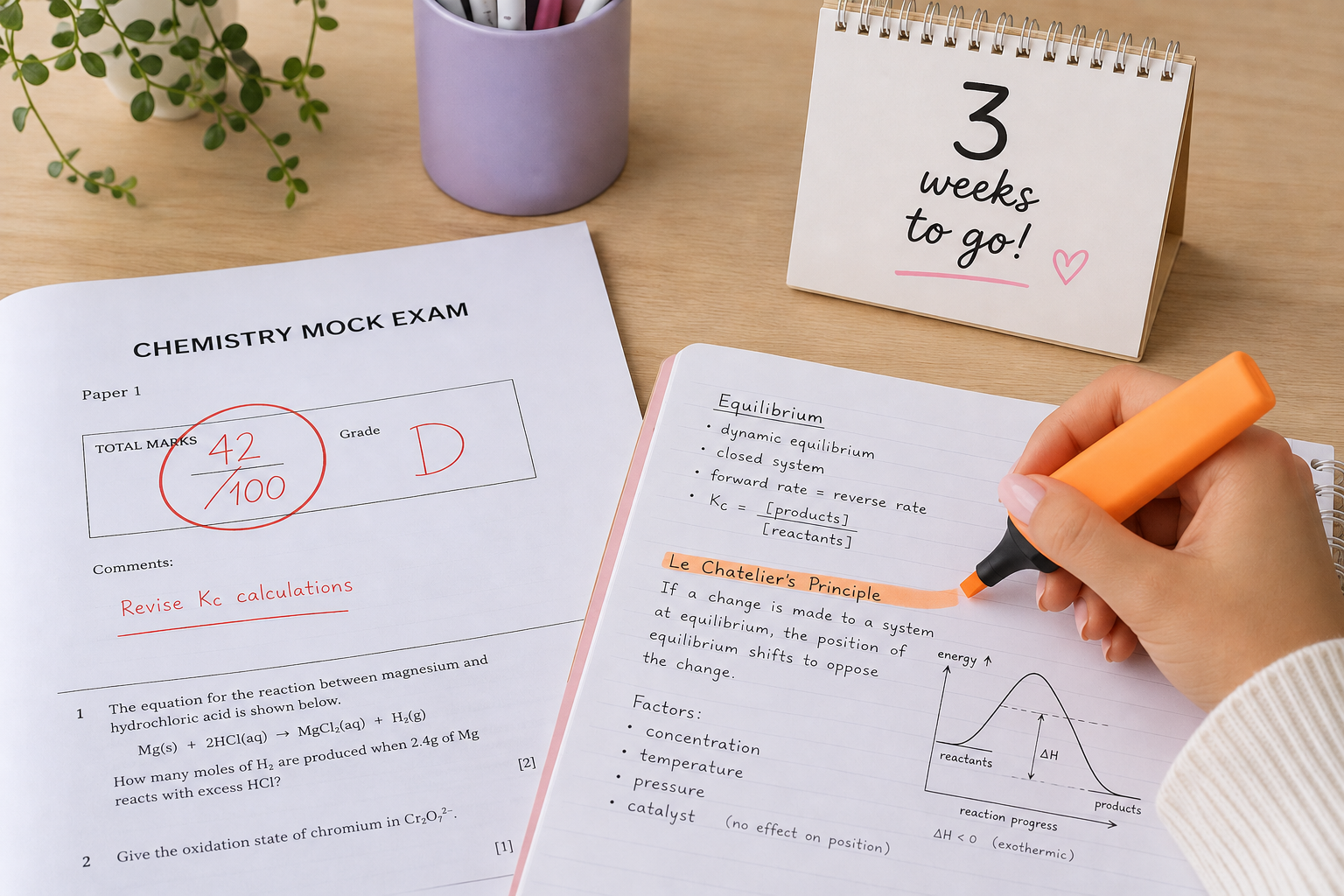
Maybe you revised for weeks and still got a D. Maybe you ran out of time in the paper. Maybe you understood everything in class but couldn’t apply it under exam pressure.
And now the real exams are close enough it’s got you feeling uncomfortable.
The important thing to understand is this:
A bad mock in March or April does not mean your final grade is fixed.
In fact, this is often the exact point where students either turn things around dramatically, or waste the final few weeks doing revision that feels productive but changes nothing.
In this blog post, I will break down exactly what you need to do next.
For students wanting a chance to still secure that uni offer, the next few weeks matter more than the last 6 months.
First, Don’t Make This Mistake
Most students respond to a bad mock emotionally.
They:
Catastrophise - “I can’t believe I forgot to convert Ea to kJ mol-1! What a rookie mistake!”
Re-read notes and highlight textbooks
Watch endless YouTube videos
Copy revision cards
Blind-panic-revise everything”
This feels safe and productive, but is ultimately ineffective because it avoids confronting the real issue.
Most exam boards (but especially OCR) at A-Level Chemistry reward application, not recognition.
You could understand content and still lose huge numbers of marks if:
Your exam technique is weak
You can’t interpret questions properly
You don’t know the mark scheme language
You revise passively instead of doing active recall
If you’re doing OCR A Chemistry, I have a Top 10 Examined A-Level Chemistry Topics resource complete with common questions, need-to-knows, model answers and pitfalls to avoid for the most commonly occurring topics from the last 5 years worth of papers.
The 48-Hour Reset Plan
After a bad mock, you need a reset period before you start serious preparation again.
Not emotional revision. Strategic revision.
Step 1: Analyse Your Mock Properly
Do not just look at the grade. Even if you got a decent score, it’s worth identifying what held you back from the top-most grade.
You need to identify:
Which topics lost the most marks
Which mistakes repeated
Whether your issue is knowledge or application
Split mistakes into 3 categories:
Knowledge gap: You genuinely didn’t know the content
Application problem: You knew it but couldn’t apply it
Exam technique issue: Timing, command words, poor structure
Most students are surprised to discover the majority of lost marks come from the second and third categories. And that’s good news because that’s where the fastest improvement can happen.
Step 2: Build a “Most Valuable Topics” List
Do not revise every topic equally.
With exams just weeks away, your job is to maximise your prep time to gain marks quickly.
Prioritise:
Commonly recurring topics
Topics with the highest marks awarded
Topics where you’re close to competence already
For OCR A Chemistry, students often gain marks fastest by focusing on these commonly appearing topics:
Organic mechanisms
Enthalpy and energetics calculations
Equilibrium
Electrolysis and redox
Practical technique questions
Transition metals
Acid-base calculations
Students waste too much time trying to perfect tiny low-yield topics while ignoring major recurring areas.
Your Weekly Exam Prep Structure
At this stage, structure matters more than motivation.
Here’s a much better revision approach for the final weeks.
Monday to Friday
1. Active Recall Session (45-60 mins)
Test yourself from memory:
Reagents and conditions
Mechanisms
Definitions
Common reactions
No notes open.
If you can’t recall it, you don’t know it properly yet.
2. Exam Question Block (60 mins)
This is where most improvement happens.
Choose:
One topic
One OCR paper section
One exam skill
Then mark it brutally using the mark scheme.
Ask yourself:
What wording did examiners want?
Where did I lose easy marks?
Did I understand and answer the actual question?
3. Error Review (20 mins)
High-grade students review their mistakes constantly.
It’s a mistake to just mark and just move on.
Keep a journal called:
“Reasons I Lose Marks”
You can apply this to other subjects too like Biology. This is one of the most valuable revision tools an A-Level student can have.
What High-Performing Students Do Differently
Students who improve from B/C grades to A/A* grades before final exams usually do three things differently (and well!).
They Prioritise Exam Technique
They stop treating Chemistry like a memory competition.
They train:
Timing
Precision
Mark scheme phrasing
Multi-step problem solving
2. They Do Hard Questions Earlier
Lower-performing students avoid difficult questions because they feel uncomfortable.
Top students deliberately prioritise them. There’s no point focusing on just what you’re already good at. It’s what you’re weak at that will bring your marks down.
3.They Review Mistakes Repeatedly
Most students see mistakes once and forget them.
Top students revisit:
The same weak topics
The same calculation errors
The same exam technique issues
Repetition is what creates consistency under pressure.
In short…
So to summarise, if you’ve only got a few weeks until the exam, stop aiming for complete revision. Aim for maximum marks gained per hours revised.Adopt this priority:
Priority 1
Topics you almost understand already
These improve quickly and boost confidence fast.
Priority 2
High-mark commonly recurring topics. I have a quick revision resource for Top 10 Examined OCR A-Level Chemistry Topics designed just for this.
Priority 3
Your personally identified weak areas that cause repeated mark loss
Not every weak topic deserves equal time.
Some topics appear constantly in exams. Others barely appear or impact your grade. A good example of this is real world applications of certain compounds e.g polymers.
FAQs
Can you still get an A after failing a Chemistry mock?
Yes, it’s possible.
Mock grades are often based on incomplete preparation and weak exam technique rather than a stern indication of final ability. They’re meant to be a diagnostic tool. If you do poorly, it exposes your weak points and gives you a focus. If you do well, it shows you what you can refine for an even better grade. Keen students can improve multiple grades before final exams with a good strategy, determination and focus.
What is the best revision method for A-Level Chemistry?
Active recall and exam question practice are usually the most effective. Passive revision like re-reading notes and watching videos often creates false confidence without improving exam performance. However, when these passive methods are combined with more active methods, the results can be powerful!
How many hours should I revise before Chemistry exams?
Quality matters more than raw hours. Consistent focused revision with exam questions and mistake review is far more effective than long passive study sessions.
Why do students lose marks in A-Level Chemistry exams?
Common reasons include:
Poor exam technique including missing key mark scheme wording
Weak application skills
Knowledge gaps
Timing issues
Insufficient preparation time
Lack of exposure to harder exam questions