
Calculations account for a significant number of marks across A-Level Chemistry, yet they're one of the areas where students most commonly lose marks through avoidable mistakes. Calculations account for up to 30% of the entire curriculum
This guide focuses on five of the most frequently examined calculation-heavy topics and teaches the exact method examiners expect to see. Rather than simply providing answers, it breaks each calculation down into a repeatable step-by-step process that students can confidently apply in exams.
Inside you'll find:
✓ Titration and back-titration calculations
✓ Rate equations, orders and rate constant (k) calculations
✓ Gibbs free energy (ΔG) calculations
✓ Buffer pH calculations
✓ Arrhenius equation calculations
Complete with:
✓ Fully worked exam-style examples
✓ Typical A/A* model answers with examiner-focused commentary
✓ Common mistakes that cost marks and how to avoid them
✓ Key formulae and exam techniques for each topic
Designed specifically for A-Level Chemistry students, this guide helps turn complex calculations into a structured process that can be repeated under exam pressure.
Perfect for students aiming to improve confidence, accuracy and exam performance in one of the most heavily tested areas of the specification.
Organic mechanisms are one of the most heavily examined areas of A-Level Chemistry and a major source of lost marks for otherwise capable students. Mechanisms can account for up to 50% of A-Level Paper 2 Exams.
Suitable for OCR and AQA exam boards.
This guide breaks down every core A-Level mechanism into simple, repeatable patterns, helping you understand why each step happens rather than relying on memorisation alone.
Inside you'll find:
✓ Free-radical substitution
✓ Electrophilic addition
✓ Nucleophilic substitution
✓ Nucleophilic addition
✓ Electrophilic substitution
✓ Elimination
Complete with:
✓ Reagents and conditions glossary
✓ Colour-coded curly arrow mechanisms
✓ Drawing curly arrow mechanisms checklist
Designed for A-Level Chemistry students aiming to improve confidence, accuracy and exam technique, this guide provides a structured approach you can apply across Paper 2 and beyond.
Created by Ope Johnson - A-Level Chemistry exam technique specialist with 15+ years of tutoring experience helping students improve confidence, exam technique and grades.
If you're revising for OCR A A-Level Chemistry, you’ve probably wondered: What topics actually come up every year? After analysing the past five years of exam papers, I’ve identified the 10 most frequently examined topics - and I’ve highlighted quick-to-digest takeaways for each topic based on what examiners want you to know. Each topic ends with:
An A* model answer to a typical question you might encounter
Common mistakes that cost marks and how to avoid them
Examiner-led commentary of how to score highly
so you can study smarter and score higher. Whether you're aiming for an A* or just trying to boost your confidence, this guide is a starting point to revising strategically.
Please note that I do not make any guarantees of future exam questions and this compilation is based solely on historical trends

So many students obsess about what to study that they don’t really stop to consider how they should study.
In this guide, I break down practical revision tips for the 3 major subject areas: Organic Chemistry, Inorganic Chemistry, and Physical Chemistry; and the unique approach each one needs so you can study more strategically
Learn how to master organic chemistry by developing a strong grasp of patterns, mechanisms, and functional groups.
Memorize patterns and link properties to principles for content-dense inorganic chemistry.
Enhance problem-solving skills and formula fluency for mathematical and concept-driven physical chemistry.
Stop studying blindly with this comprehensive A-Level Chemistry guide. Dive into Organic, Inorganic, and Physical Chemistry with expert strategies and practical tips to study smarter, not harder. Learn how to tailor your revision for each discipline and take control of your Chemistry A-Level success.

Discover how to study in a way that actually works for you. This concise, practical guide helps students identify their natural motivation style, energy rhythms, ideal study environment, and attention patterns—so revision becomes more focused, less stressful, and far more effective.
Grounded in real student experience and filled with reflective prompts, it empowers learners to stop copying what “everyone else” is doing and instead build a revision approach that feels natural, sustainable, and confidence‑boosting.
A perfect addition to your A-Level Chemistry arsenal, this guide helps students study smarter by working with their strengths, not against them.
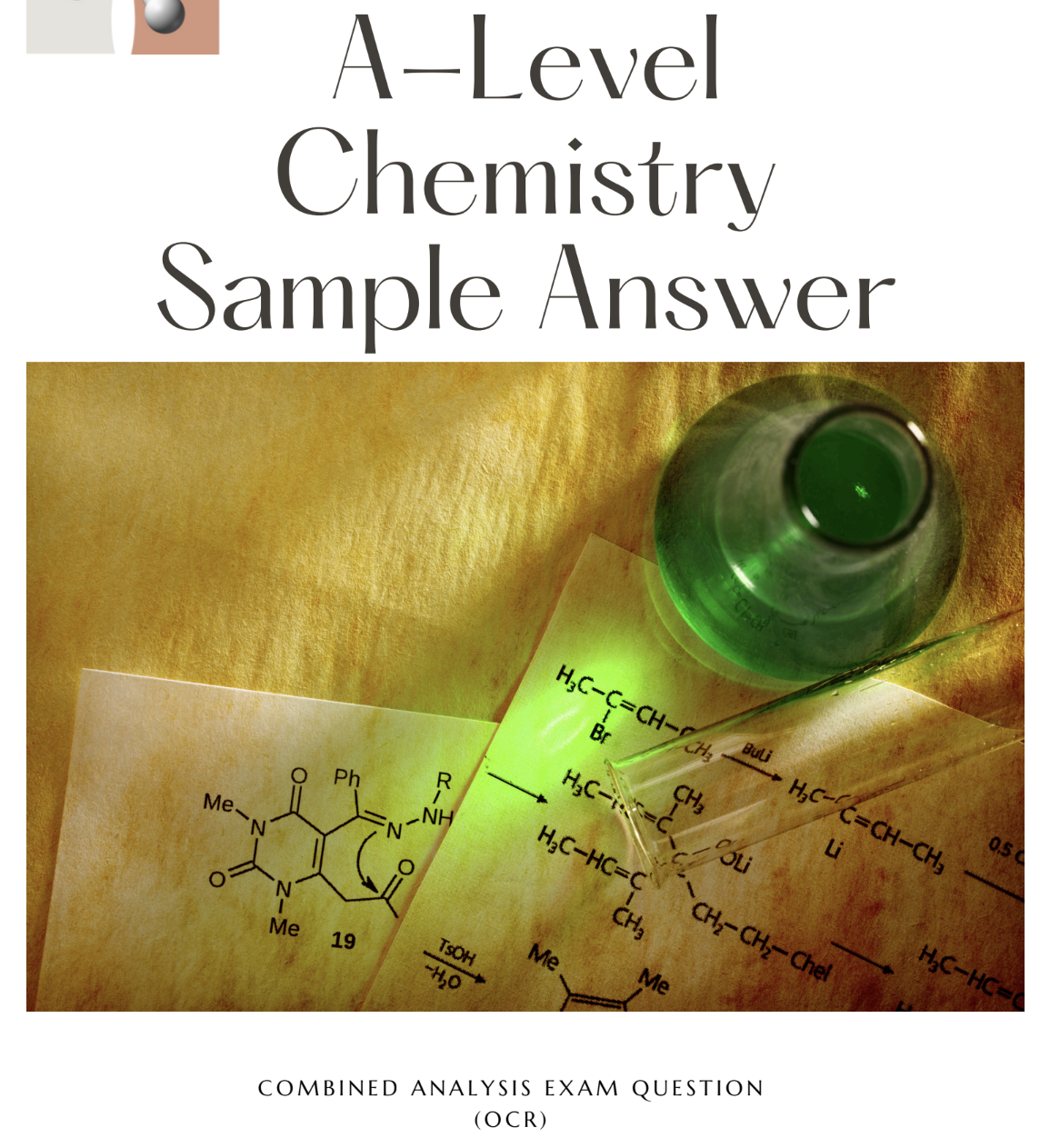
I created this resource with you in mind. It is specific to the OCR A exam board and features a real past exam question. I’ve designed this in such a way as to provide a comprehensive model A* answer, highlighting common pitfalls. This topic is examined every year and constitutes a significant portion of the A-Level paper 2 exam
A simple, organised way to keep track of your A‑Level Chemistry revision. Every topic from Modules 2–6 is laid out clearly with relevant sub-topics, and space to tick off what you’ve learnt, what you’ve revised, and which past‑paper questions you’ve practised. You can also rate your confidence as you go, making it easier to spot what needs more attention and what’s already feeling solid. It’s a straightforward tool to help you stay on top of the spec and revise a bit more intentionally.
No results match your search. Try removing a few filters.
