OCR A-Level Chemistry Exam Technique: How Questions Really Work
Strong OCR A-Level Chemistry exam technique is not just about knowing the chemistry. It is about recognising what type of answer the question is asking for.
OCR exam questions are built around three Assessment Objectives: AO1, AO2 and AO3. These assess different skills, from recalling accurate chemistry knowledge to applying it in unfamiliar situations and analysing evidence.
Students can lose marks even when their chemistry is correct if they answer at the wrong level, use vague wording, or fail to respond to the command word. In this guide, I’ll explain what AO1, AO2 and AO3 mean, how they appear in OCR A-Level Chemistry questions, and how to structure answers that are more likely to pick up the available mark-scheme points.
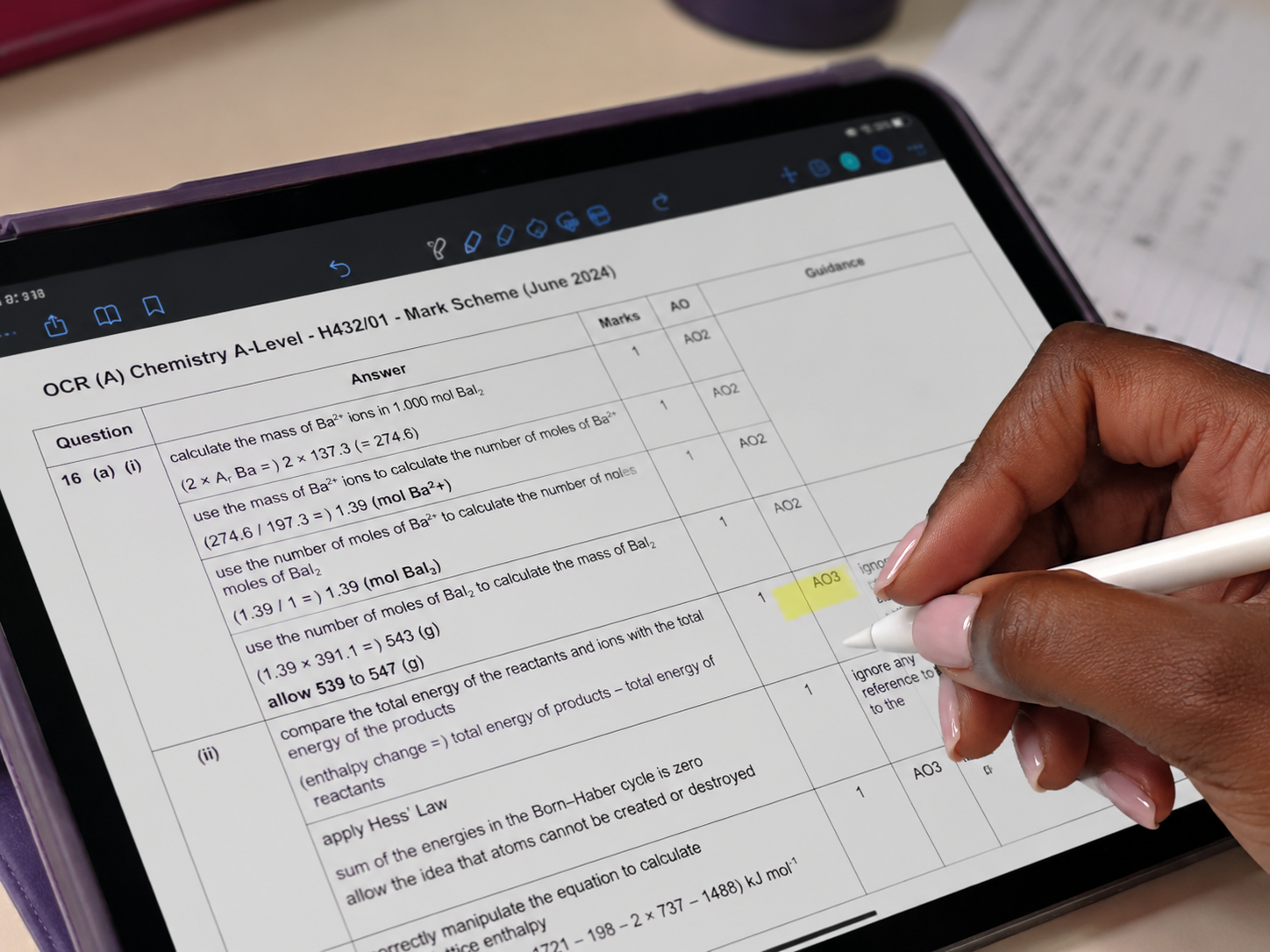
Understanding AO1, AO2 and AO3 Mark Scheme Points
Many A-Level Chemistry students revise hard but still miss marks in exams. You might know the content, complete past papers, even go through the mark schemes… and still find it difficult to move up to your target A or A* grade.
One of the biggest reasons is this:
Students often answer the wrong type of question. Even students that regularly use the mark schemes in their past paper practice, sometimes fall short because of this.
OCR A-Level Chemistry questions are built around three Assessment Objectives, usually called AO1, AO2 and AO3. Each one tests a different skill. If you do not recognise what the examiner is actually asking for, you can lose marks even if your chemistry knowledge is scientifically correct.
This guide breaks down what each AO means, the command words linked to it, and how to answer these questions more effectively in OCR Chemistry exams. When put into practice, it’ll help you think like an examiner and score higher by being more precise.
So What are Assessment Objectives in OCR A-Level Chemistry?
OCR uses Assessment Objectives to test different scientific skills, not just factual recall.
The three Assessment Objectives are:
| Assessment Objective | What it tests | |
|---|---|---|
| AO1 | Knowledge and understanding | |
| AO2 | Applying chemistry in unfamiliar situations | |
| AO3 | Analysis, interpretation and evaluation |
Understanding these is one of the best ways to improve your exam technique in A-Level Chemistry.
AO1: Demonstrate Knowledge and Understanding
AO1 questions test your ability to recall and explain chemistry accurately.
These are usually the most straightforward questions in the paper, but students still lose easy marks if they fail to use precise mark-scheme teerminology.
Common AO1 command words
| Command word | What the examiner wants |
|---|---|
| State | Give a short factual answer |
| Define | Give the precise scientific meaning |
| Describe | Say what happens |
| Explain | Give a chemical reason why |
| Give | Provide a relevant fact or example |
OCR AO1 examples
Some examples of typical OCR-style AO1 questions include:
Define electronegativity
State the oxidation number of sulfur in HSO₃⁻
Explain why magnesium chloride conducts electricity when molten but not when solid
What examiners are actually looking for
OCR examiners reward:
Precise scientific language
Chemically accurate explanations
Correct terminology
Logical sequencing of ideas
For example, many students write:
"Chlorine has stronger forces."
That is too vague.
A stronger AO1 answer would be:
"Chlorine has more electrons, so it experiences stronger London dispersion forces."
That level of precision matters.
Common AO1 mistakes
Students often lose AO1 marks because they:
Use vague wording
Miss key chemical terms
Describe instead of explain
AO2: Apply Knowledge and Understanding
AO2 questions test whether you can use chemistry in unfamiliar contexts.
This is where many students struggle.
You may know the chemistry content well, but AO2 asks you to adapt that knowledge to a new situation.
Common AO2 command words
| Command word | What the examiner wants |
|---|---|
| Calculate | Use data and working to find an answer |
| Predict | Use chemistry knowledge to say what will happen |
| Suggest | Apply chemistry logically to a new context |
| Determine | Work out the answer from information given |
| Deduce | Reach a conclusion using evidence |
OCR AO2 examples
Examples of AO2 questions could include:
Calculate the pH of the resulting mixture when propanoic acid is mixed with sodium hydroxide
Determine the shape of the B-N-F bond in a molecule of 3HNBF3
Suggest 3 possible structures for a cyclic compound with the molecular formula C6H10O2
Why students lose marks in AO2
Students often:
Memorise facts without knowing how to apply them
Use equations incorrectly
Fail to connect evidence to conclusions
For calculations, OCR usually awards marks for:
Method
Final answer, and
Units
That means you should always show clear working, even if you are unsure of the final answer.
How to improve AO2 answers
To score higher AO2 mark points :
Identify the chemistry topic being tested
Link what you know to the unfamiliar context
Explain each step logically (use headers to categorise your answer if applicable)
Show full working in calculations
Use evidence from the question
AO3: Analyse, Interpret and Evaluate
AO3 is the highest-level skill awardable in OCR A-Level Chemistry exams.
These questions test whether you can think like a scientist.
Common AO3 command words
| Command word | What the examiner wants |
|---|---|
| Evaluate | Judge strengths and weaknesses using evidence |
| Assess | Decide how valid or important something is |
| Compare | Identify similarities and differences |
| Analyse | Interpret patterns or trends |
| Discuss | Explore different sides logically |
OCR AO3 examples
Examples of typical AO3 questions include:
Evaluate the reliability of (provided) experimental data
Suggest improvements to a student's practical method
Analyse trends in ionisation energies
Assess the advantages and disadvantages of a chemical reaction on a large scale
The final example is especially useful because a student needs to consider multiple factors such as yield, cost, safety, atom economy and environmental impact. That is exactly the type of thinking OCR rewards at high levels.
What examiners are actually looking for
Strong AO3 answers usually follow this structure:
Identify evidence
Interpret it chemically
Reach a justified conclusion
This is where many students go wrong.
Instead of analysing data, they simply describe it.
For example:
❌ "The reaction is exothermic."
Better AO3 analysis:
✅ "The reaction is exothermic because more energy is released as bonds form, than energy is absorbed when they break."
Common AO3 mistakes
Students often:
Make claims without evidence
Describe instead of analyse
Give generic practical improvements such as "repeat the experiment".
(A better improvement would explain:
what should be improved,
why it matters,
and how it increases reliability or accuracy.)
How OCR Exam Questions Combine AO1, AO2 and AO3
Many longer OCR Chemistry questions combine all three Assessment Objectives.
For example:
| Level Type | Typical AO balance |
|---|---|
| Level 1 | Basic AO1 recall |
| Level 2 | AO1 knowledge plus some AO2 application |
| Level 3 | Strong AO2 and AO3 analysis that is chemically sound, follows a logical train of thought |
This is why top students do more than memorise facts.
They:
Apply chemistry to unfamiliar situations
Analyse evidence carefully
Use precise scientific explanations
Justify conclusions logically
Why Students Lose Marks in OCR Chemistry
According to examiner reports, students often lose marks because they:
Answer at the wrong AO level
Describe instead of explain
Fail to apply the correct chemistry to the context
Give conclusions without evidence
Understanding the Assessment Objectives helps you avoid these mistakes.
It also makes revision more effective because you stop treating every question the same way.
How to Use This in Your Revision
If you’re trying to revise A-Level chemistry quickly, when completing OCR Chemistry past papers, stop asking:
"Did I get the answer right?"
Instead ask:
What were the command words?
Did I explain or just describe?
Did I apply the chemistry to the context?
Did I support my conclusion with evidence?
That mindset shift alone can improve your answers significantly.
Quick Summary
AO1
Recall and explain chemistry accurately.
AO2
Apply chemistry knowledge to unfamiliar situations.
AO3
Analyse evidence, evaluate methods and justify conclusions.
The highest-performing A-Level Chemistry students recognise which skill is being tested before they even start writing.
FAQs
What is AO1 in A-Level Chemistry?
AO1 tests your knowledge and understanding of chemistry facts, definitions, equations and explanations.
What is the hardest Assessment Objective in OCR Chemistry?
Most students find AO3 hardest because it requires analysis, evaluation and evidence-based conclusions.
How do you improve AO2 in Chemistry?
Practice applying chemistry to unfamiliar questions rather than memorising mark schemes.
Why do students lose marks in OCR Chemistry?
Students often describe instead of explain, fail to apply chemistry to the question, or give conclusions without evidence.
Final Thoughts
Improving in OCR A-Level Chemistry is not just about revising more content.
It is about understanding how examiners think.
Once you recognise the difference between AO1, AO2 and AO3 questions, your answers become clearer, more structured, and far more likely to reach the top mark bands.
If you are stuck at a B or C grade despite revising hard, exam technique is usually the missing piece. And understanding how marks are awarded, not just specific mark scheme phrasing is one of the primary focuses of my tutoring programmes. This help students improve their OCR Chemistry exam technique step-by-step, so they can turn chemistry knowledge into higher marks.