How to Revise A-Level Chemistry Fast
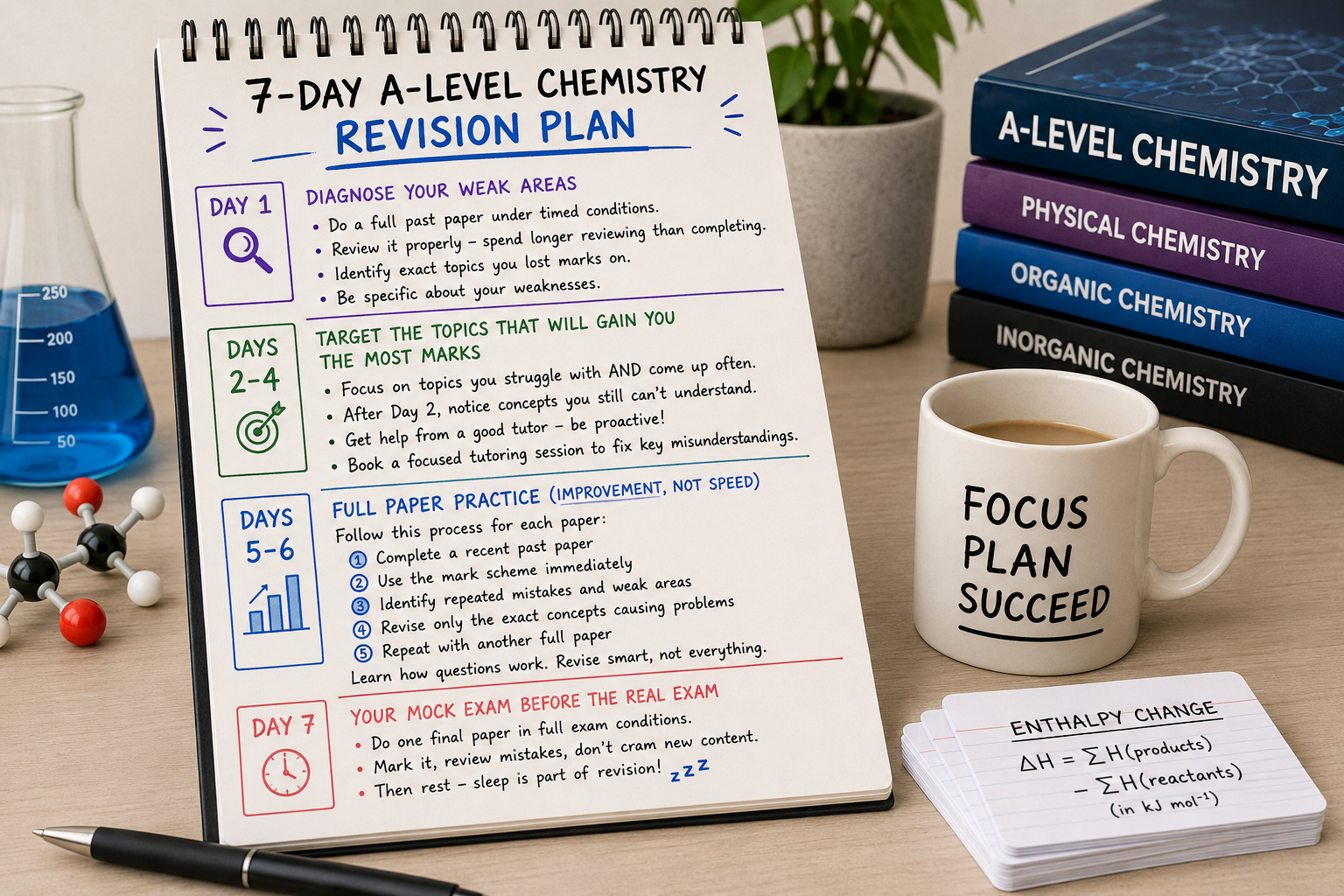
A 7-Day Plan That Actually Works
If you’ve only got a limited time left before your A-Level Chemistry exam, don’t panic and try to relearn the entire course.
At this stage, the students who improve fastest are not the ones revising the longest. They’re the ones revising with structure.
Many students make the same mistake in the final week. They reread notes, highlight textbooks, and jump randomly between topics. It feels productive, but it rarely leads to more marks.
Instead, your revision now needs to focus on three things:
Finding the topics that lose you marks
Improving exam technique
Repeating high-value practice under pressure
This is the exact approach I encourage my students to follow in the final month before exams, especially when they want to jump 1 or more grades. So here’s a practical 7-day plan you can implement to make use of your time wisely in the coming days.
Disclaimer:
This revision plan is designed for students who already have a solid understanding of most A-Level Chemistry content and need a focused, intensive approach to improve exam performance quickly.
It is particularly useful for students currently working around a B or C grade who are aiming to push into the A or A* range by improving exam technique, question interpretation, and application of knowledge under exam conditions.
This guide assumes you are already familiar with the majority of the specification and can recognise most core concepts when you see them.
If you are still struggling with large sections of the course content or regularly finding entire topics unfamiliar, this is probably not the best revision approach for you yet. In that situation, your priority should be rebuilding core understanding first, ideally with structured support from a teacher or tutor, before focusing heavily on exam technique and timed practice.
Day 1: Diagnose Your Weak Areas
If you haven’t already, start by doing a recent past paper fully.
Do it properly under timed conditions so you can see how you actually do when you’re under pressure.
Then spend some time reviewing the paper.
Ask yourself:
Did I lose marks because of knowledge gaps or exam technique?
Were there calculations or practical questions I kept struggling with?
Create a list of weak topics or concepts. Be specific.
Don’t write down “equilibrium”. Instead, write “explaining equilibrium shifts using Le Chatelier’s principle” or “Kc calculations”.
That level of detail matters because it gives you a very targeted area to improve on.
Days 2 to 4: Target the Topics That Gain the Most Marks
Now focus on the topics that:
You struggle with AND
Come up regularly in exams
These are the areas most likely to improve your grade quickly.
If you’re unsure which topics appear most often, read our guide to the most commonly examined A-Level Chemistry topics.
Use topic-based exam questions from sites like Physics & Maths Tutor and practise answering them with the mark scheme beside you.
The mark scheme is one of the fastest diagnostic tools available to you.
It teaches you:
The exact wording examiners want
How many points you need to make for a given mark
Common mistakes that lose marks
A lot of students know the chemistry but still lose marks because their answers are too vague.
After Day 2, you should also start noticing whether there are certain concepts you still cannot understand properly, even after reviewing notes, videos, and mark schemes.
That is usually a sign that you need help from a good tutor. Here’s a post on what to consider when choosing s good tutor.
Don’t just wish it away or try to do it again on your own. Get expert help.
Before going into a tutoring session:
Write down the exact questions or concepts confusing you
Gather examples of questions you got wrong
Book a focused tutoring session to work through them properly
Often, one strong explanation can fix a misunderstanding that has been costing you marks for months.
Days 5 and 6: Full Paper Practice
At this point, switch back to doing full papers.
Aim to complete at least three papers across these two days.
However, don’t work under timed conditions yet. Right now, the goal is improvement, not speed.
Your process should look like this:
Complete a whole paper carefully
Use the mark scheme immediately afterwards
Identify mistakes and weak areas
Revise only the exact concepts causing problems
Redo similar questions until it clicks
Repeat steps 1-5
This stage is about learning how exam questions work.
You want to slow down enough to notice:
How questions are phrased
Which keywords trigger certain answers
Where marks are actually awarded
Which mistakes keep repeating
Don’t spend an hour revising an entire topic because of a specific mistake.
If you got a buffer calculation wrong, revise acidic buffers specifically. Keep your revision targeted and efficient.
This is how you revise A-Level Chemistry fast without wasting any more time on content you already know.
Day 7: Your Mock Exam Before the Real Exam
The day before the exam, complete one final paper under full exam conditions.
That means:
Quiet room
Phone away
Scientific calculator ready
Data sheet and periodic table prepared
Strict timing (no breaks)
Treat it exactly like the real thing.
This helps reduce panic on exam day because your brain has already practised the routine.
After marking the paper, review mistakes calmly. Don’t try to cram brand new content late at night.
Then rest.
Sleep is part of revision. A tired brain makes careless mistakes that cost dear marks.
Want More OCR Chemistry Exam Support?
If you'd like more help identifying the topics most likely to appear in your OCR Chemistry exams, download my free guide:
"5 Most Examined A-Level Chemistry Topics and How A/A* Students Answer Them"
Inside, you'll discover:
OCR topics that come up repeatedly
common mistakes students make
answer techniques to common exam questions high-performing students use to maximise marks.
It's designed specifically for OCR A-Level Chemistry students who want to revise more strategically, improve their exam technique, and feel more confident going into their exams.
What Examiners Are Actually Looking For
Examiners are not looking for you to regurgitate perfectly crammed information in every answer.
They want:
Precise scientific language
Logical working shown in calculations
Clear application of chemistry ideas to unfamiliar scenarios
Answers that directly address the question (explain, justify, suggest etc)
That’s why past paper practice matters so much in the final week.
It conditions you for the real exam.
FAQs
How can I revise A-Level Chemistry quickly?
The fastest way is to stop revising everything equally. Focus on weak topics that appear often in exams, use past paper questions, and learn directly from mark schemes.
Can I improve my A-Level Chemistry grade in one week?
Yes, especially if your biggest problem is exam technique. Many students already know more chemistry than they realise but lose marks because of vague answers, poor structure, or weak application.
Should I memorise the textbook in the final week?
No. The final week should focus on exam questions and applying knowledge. Passive revision like rereading notes is usually far less effective than active practice.
How many past papers should I do before the exam?
Aim for at least 4 to 6 papers across the final week. Quality review matters more than quantity. Spend time understanding mistakes instead of rushing through papers.
When should I get a tutor for A-Level Chemistry?
If you repeatedly cannot understand certain concepts after independent revision, it’s worth getting expert help. A focused session on your weakest areas can save a huge amount of wasted revision time. If you’re interested in a session with me, book a trial here.
Key Takeaways
Start with diagnosis, not rereading notes
Focus on weak topics that appear often in exams
Use mark schemes to improve exam technique
Practise full papers effectively before introducing timing
Revise specific weaknesses, not entire topics
Simulate exam conditions before the real exam
Prioritise rest the night before