Why You Should Choose a Chemistry Tutor Who Specialises in Your Child’s Exam Board
Not all A-Level Chemistry tutoring is the same.
A tutor may understand Chemistry well, but that does not automatically mean they can translate what your child’s exam board really requires for an A/A* grade. For A-Level Chemistry, that difference matters.
OCR A, AQA and Edexcel all cover broadly similar chemical ideas, but they do not always test them in the same way. The wording, topic emphasis, practical requirements, mark scheme style and question patterns vary.
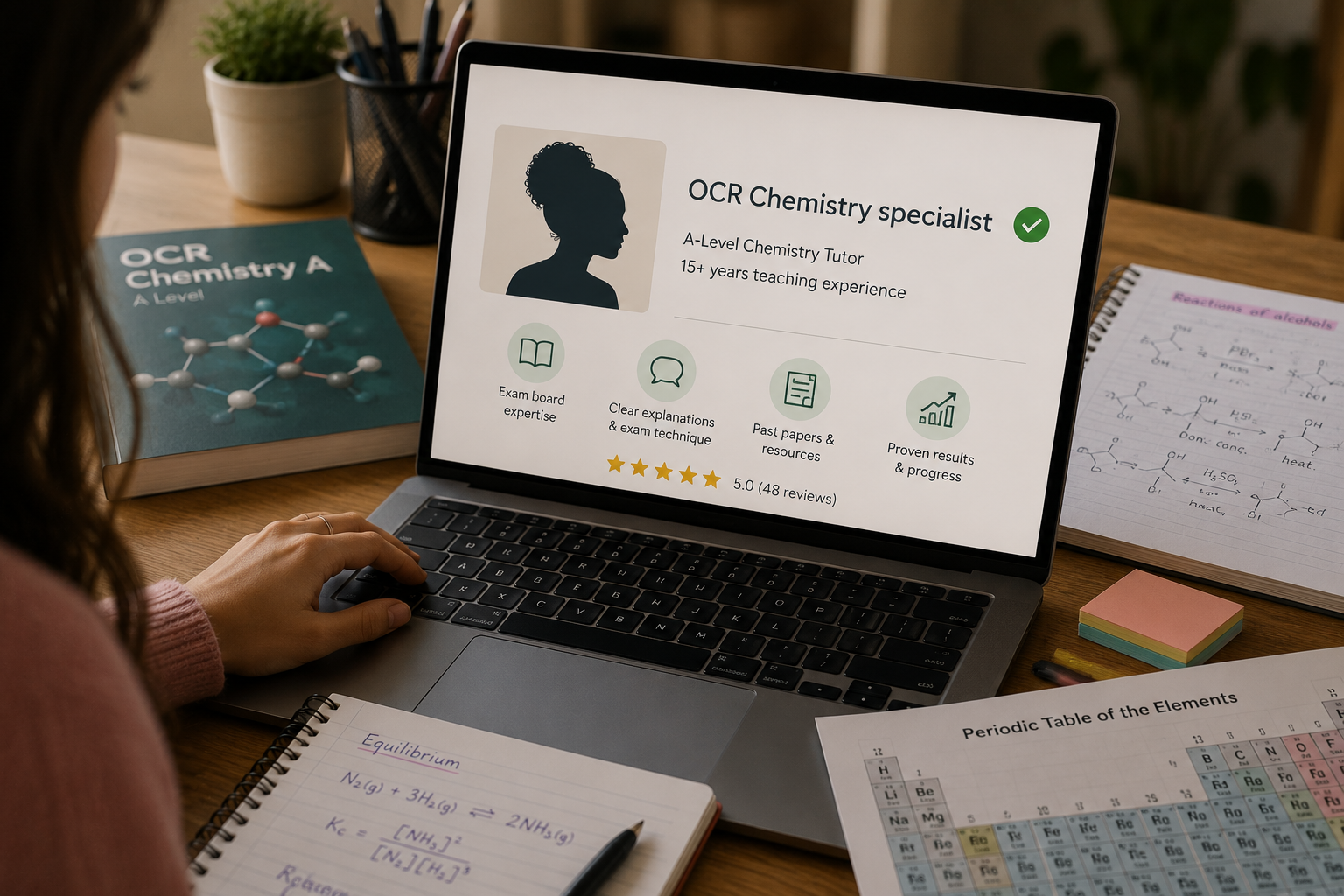
Why does exam board-specific Chemistry tutoring matter?
Because students are not just trying to understand Chemistry. They are trying to gain marks in a specific exam which translates to a target grade. That target grade in turn could be their entry ticket to a coveted university place to study their dream course.
A strong exam board-specific tutor knows:
what the specification includes
what the exam board tends to ask
how mark schemes phrase answers
which topics are frequently examined
what common mistakes students make
how to train answers for that particular exam board
This is especially important for OCR A-Level Chemistry.
OCR questions often ask students to apply knowledge to unfamiliar contexts. A student may know the topic but still lose marks because they do not answer at the right level, miss key terminology or fail to use the data given.
Content knowledge is not enough
Many students say, “I understand it in class, but I lose marks in exams.”
That usually means the issue is not only knowledge. It is exam technique.
An exam board-focused tutor can show your child how to:
interpret command words
structure calculations
use precise scientific language
approach unfamiliar questions
avoid common mark scheme traps
connect topic knowledge across papers
What examiners are actually looking for
Examiners reward answers that match the mark scheme. Simply put. That does not mean memorising every mark scheme word-for-word. It means understanding the level of precision expected.
For example, “particles have more energy” may not be enough. A stronger answer might refer to kinetic energy, successful collisions and activation energy, depending on the question.
A tutor who understands the exam board can help your child move from broad understanding to mark-winning answers.
Questions to ask before choosing a tutor for your child
Investing in a tutor is a significant decision that you make regarding your child’s education and possible future career choices. Not to mention the financial commitment. It’s worth making sure that your hard-earned pounds are being put to good use. Before settling on your child’s next tutor, consider some important factors and ask:
- Which exam boards do you teach most often?
- Do you use exam board-specific past paper questions?
- How do you teach exam technique?
- Do you help students understand mark schemes?
- Can you explain how this exam board asks questions?
Final tutor insight
The right tutor should not just be able to explain Chemistry, or have graduated with a good degree (althought these are fairly important metrics). They should also be able to help your child understand how their exam board wants that Chemistry communicated.
Next step: Download my free 5 Most Examined A-Level Chemistry Topics guide. It includes model A/A* answers and examiner-focused explanations to help students see what stronger exam responses look like.