How to Prepare for OCR A-Level Chemistry Paper H432/03
OCR A-Level Chemistry Paper H432/03, Unified Chemistry, is often the paper students underestimate.
By the time Paper 3 arrives, students are tired. They may feel they have already done the “main” papers. But Paper 3 matters because it pulls the whole course together. It can test practical skills, calculations, organic analysis, data handling, written explanations and unfamiliar contexts in one paper.
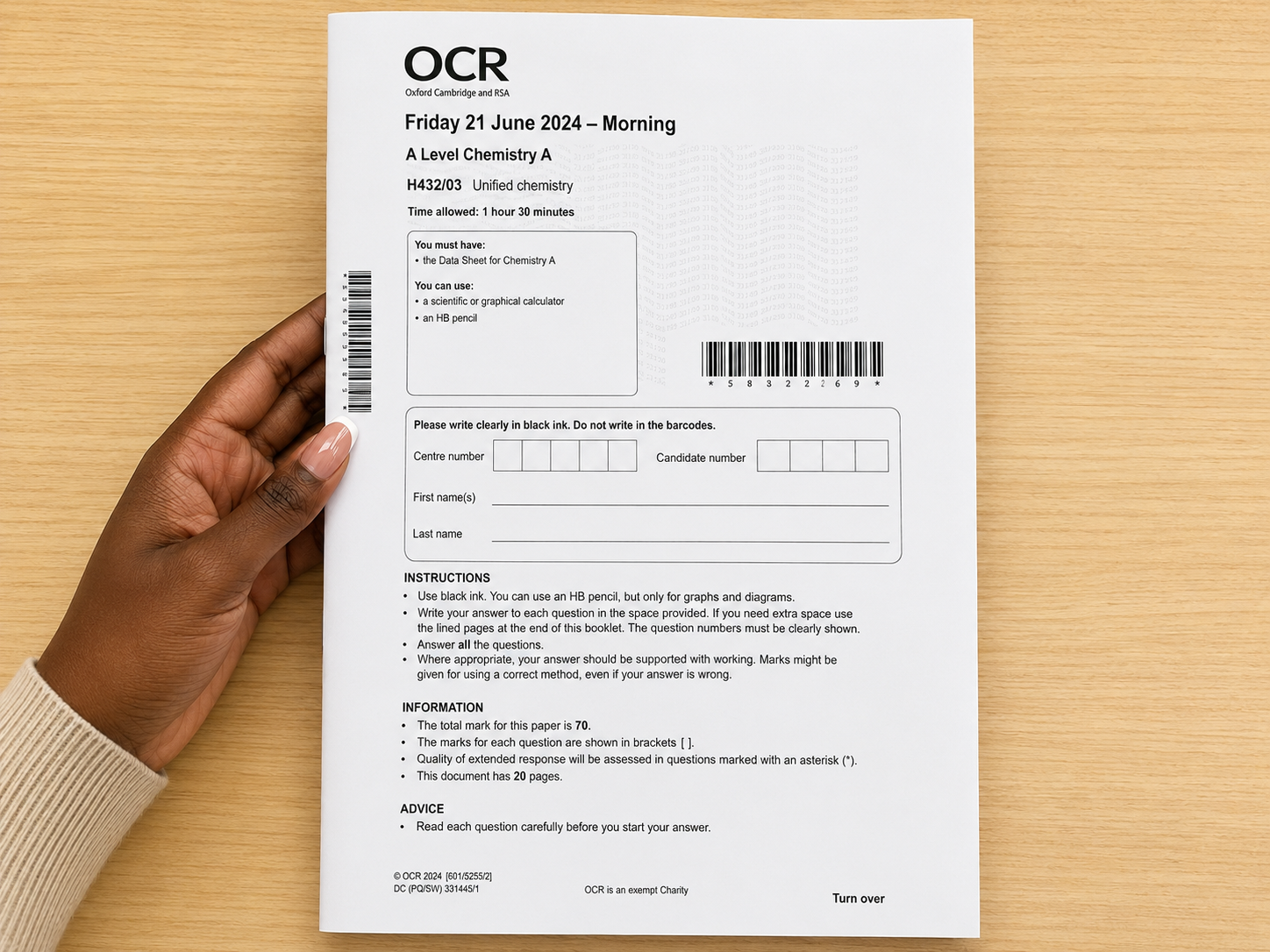
How should students prepare for OCR A-Level Chemistry Paper H432/03?
The best way is not to relearn the whole course. It’s to practise linking topics together.
Paper 3 rewards students who can move between ideas. A question might begin with practical data, move into rates, require a calculation, then ask for an explanation using particle theory. Another question might combine organic synthesis with spectroscopy.
That means your revision needs to be mixed, timed and exam-focused.
Start with your weak question types
Don’t just write “physical chemistry” or “organic chemistry” as weak areas. Be more specific.
For example:
- I don’t know how to calculate pH for a buffer solution
- I forget which way the curly arrows go in mechanisms
- I struggle to explain graph trends
- I forget to convert units in multi-step calculations
- My answers aren’t specific enough for practical evaluation questions
This helps you revise the exact skill that is costing marks.
Practise practical and data questions
Paper 3 often exposes students who can recall content but cannot interpret evidence.
When practising, train yourself to:
- link your answer to exact values from graphs or tables
- explain trends using Chemistry, do not just describe
- show full calculation working, including showing any key equations used
- include units and significant figures
- link practical improvements to accuracy or reliability
What examiners are actually looking for
Examiners want to see clear thinking. That means your answer should not just be correct. It should be easy to mark.
For calculations, show each step. For explanations, use precise Chemistry language. For evaluation questions, make a point, support it with evidence, then explain why it matters.
The strongest students don’t panic when a question looks unfamiliar. They ask, “What topic is this really testing?” Then they pull out the relevant formula, mechanism, definition or practical idea. Follow the command words closely and pay attention to method marks. All this helps to improve exam technique on paper 3.
Action steps before Paper 3
- Complete at least two Paper 3 past papers under timed conditions
- Review every lost mark and label the reason
- Practise mixed-topic questions, not just topic-by-topic revision
- Revisit practical skills and graph interpretation
- Memorise key definitions, formulae and organic conditions
- Practise writing concise explanations
Final tutor insight
Paper 3 is not about guessing what will come up. It’s about becoming flexible enough to handle whatever OCR puts in front of you.
Next step: Download my free 5 Most Examined A-Level Chemistry Topics guide. It gives students high-value topics, common mistakes and model A/A* style answers so they can revise with more precision before the final papers.
FAQs
-
OCR A-Level Chemistry Paper H432/03 is the Unified Chemistry paper, and the final paper in the A-Level Chemistry series. It brings together content from across the OCR A-Level Chemistry course and often tests students on practical skills, data analysis, calculations and unfamiliar applications.
-
The best way to revise for Paper 3 is to practise mixed-topic questions, especially topics that incorporate multi-step calculations and practical insights. Students should complete timed past papers, review practical skills, practise calculations and work on linking topics rather than revising each topic in isolation.
-
Students often find Paper 3 difficult because the questions can feel less predictable. The paper expects students to apply knowledge across the whole course, interpret data and explain ideas clearly using precise Chemistry language.
-
Students should focus on practical skills, amount of substance, organic analysis, rates, acids and bases, enthalpy, redox, transition metals and data handling. However, Paper 3 can draw from the full specification.
-
To improve exam technique, students should show full working in calculations, underline key command words, use data from the question, write precise explanations and review mark schemes carefully after each past paper.